import matplotlib.pyplot as plt
import numpy as np
import pandas as pd
import yfinance as yfMcKinney Chapter 5 - Practice for Section 05
FINA 6333 for Spring 2024
1 Announcements
- No DataCamp this week, but I suggest you keep working on it
- Keep forming groups, and I will post our first project early next week
2 10-Minute Recap
%precision 4
pd.options.display.float_format = '{:.4f}'.format
%config InlineBackend.figure_format = 'retina'
pandas gives us two data structures:
- Data Frames
- Series
A data frame is like a worksheet in an Excel workbook.
np.random.seed(42)
df = pd.DataFrame(
    data=np.random.randn(3, 5), # 15 random numbers
    index=list('ABC'), # labels the rows for easy indexing and slicing
    columns=list('abcde') # labels the columns for easy indexing and slicing
)

df| a | b | c | d | e | |
|---|---|---|---|---|---|
| A | 0.4967 | -0.1383 | 0.6477 | 1.5230 | -0.2342 |
| B | -0.2341 | 1.5792 | 0.7674 | -0.4695 | 0.5426 |
| C | -0.4634 | -0.4657 | 0.2420 | -1.9133 | -1.7249 |
How can we get the first two rows and first three columns?
- We can slice by integer location with the
.iloc[]method - We can slice by names with the
.loc[]method
df.iloc[:2, :3] # j,k slicing, as in NumPy| a | b | c | |
|---|---|---|---|
| A | 0.4967 | -0.1383 | 0.6477 |
| B | -0.2341 | 1.5792 | 0.7674 |
When we slice by names, both left and right edges are included!
df.loc['A':'B', 'a':'c']| a | b | c | |
|---|---|---|---|
| A | 0.4967 | -0.1383 | 0.6477 |
| B | -0.2341 | 1.5792 | 0.7674 |
We can use the .head() method to show the first n rows in df.
df.head(2)| a | b | c | d | e | |
|---|---|---|---|---|---|
| A | 0.4967 | -0.1383 | 0.6477 | 1.5230 | -0.2342 |
| B | -0.2341 | 1.5792 | 0.7674 | -0.4695 | 0.5426 |
How do I add a column?
df['f'] = 5 # as in NumPy, this 5 will broadcast to all the rows

df| a | b | c | d | e | f | |
|---|---|---|---|---|---|---|
| A | 0.4967 | -0.1383 | 0.6477 | 1.5230 | -0.2342 | 5 |
| B | -0.2341 | 1.5792 | 0.7674 | -0.4695 | 0.5426 | 5 |
| C | -0.4634 | -0.4657 | 0.2420 | -1.9133 | -1.7249 | 5 |
A series is like a single column in an Excel worksheet (or a pandas data frame).
ser = pd.Series(data=np.arange(2.), index=list('BC'))

ser
B 0.0000
C 1.0000
dtype: float64pandas aligns operations on row and column names
df['g'] = ser

df| a | b | c | d | e | f | g | |
|---|---|---|---|---|---|---|---|
| A | 0.4967 | -0.1383 | 0.6477 | 1.5230 | -0.2342 | 5 | NaN |
| B | -0.2341 | 1.5792 | 0.7674 | -0.4695 | 0.5426 | 5 | 0.0000 |
| C | -0.4634 | -0.4657 | 0.2420 | -1.9133 | -1.7249 | 5 | 1.0000 |
3 Practice
tickers = 'AAPL IBM MSFT GOOG'
prices = yf.download(tickers=tickers)
[*********************100%%**********************] 4 of 4 completedreturns = (
prices['Adj Close'] # slice adj close column
.iloc[:-1] # drop last row with intra day prices, which are sometimes missing
.pct_change() # calculate returns
.dropna() # drop leading rows with at least one missing value
)
returns| AAPL | GOOG | IBM | MSFT | |
|---|---|---|---|---|
| Date | ||||
| 2004-08-20 | 0.0029 | 0.0794 | 0.0042 | 0.0029 |
| 2004-08-23 | 0.0091 | 0.0101 | -0.0070 | 0.0044 |
| 2004-08-24 | 0.0280 | -0.0414 | 0.0007 | 0.0000 |
| 2004-08-25 | 0.0344 | 0.0108 | 0.0042 | 0.0114 |
| 2004-08-26 | 0.0487 | 0.0180 | -0.0045 | -0.0040 |
| ... | ... | ... | ... | ... |
| 2024-01-26 | -0.0090 | 0.0010 | -0.0158 | -0.0023 |
| 2024-01-29 | -0.0036 | 0.0068 | -0.0015 | 0.0143 |
| 2024-01-30 | -0.0192 | -0.0116 | 0.0039 | -0.0028 |
| 2024-01-31 | -0.0194 | -0.0735 | -0.0224 | -0.0269 |
| 2024-02-01 | 0.0133 | 0.0064 | 0.0176 | 0.0156 |
4896 rows × 4 columns
3.1 What are the mean daily returns for these four stocks?
returns.mean() # default is axis=0, so we get the mean of each columnAAPL 0.0014
GOOG 0.0010
IBM 0.0004
MSFT 0.0008
dtype: float64We if want an equally-weighted portfolio return? We could take the mean of each row with .mean(axis=1). The mean is the same as the sum of 0.25 times each of the 4 columns.
returns.mean(axis=1)Date
2004-08-20 0.0224
2004-08-23 0.0041
2004-08-24 -0.0032
2004-08-25 0.0152
2004-08-26 0.0146
...
2024-01-26 -0.0065
2024-01-29 0.0040
2024-01-30 -0.0074
2024-01-31 -0.0356
2024-02-01 0.0132
Length: 4896, dtype: float643.2 What are the standard deviations of daily returns for these four stocks?
We can use the .std() method to find the sample standard deviation of each column.
returns.std()AAPL 0.0206
GOOG 0.0194
IBM 0.0143
MSFT 0.0171
dtype: float643.3 What are the annualized means and standard deviations of daily returns for these four stocks?
We annualize mean returns by multiplying by \(T\) (\(T=252\) for daily returns, \(T=12\) for month returns, and so on). We annualize standard deviations by multiplying by \(\sqrt(T)\).
returns.mean().mul(252) # whenever I can, I use the .mul() method, so I can keep chaining!AAPL 0.3625
GOOG 0.2552
IBM 0.0980
MSFT 0.2002
dtype: float64returns.std().mul(np.sqrt(252))AAPL 0.3276
GOOG 0.3074
IBM 0.2272
MSFT 0.2722
dtype: float643.4 Plot annualized means versus standard deviations of daily returns for these four stocks
Use plt.scatter(), which expects arguments as x (standard deviations) then y (means).
vols = returns.std().mul(np.sqrt(252) * 100)
means = returns.mean().mul(252 * 100)

plt.scatter(
    x=vols,
    y=means
)

plt.xlabel('Annualized Volatility of Daily Returns (%)')
plt.ylabel('Annualized Mean of Daily Returns (%)')

# plt.xlim((0, vols.max() + 5))
# plt.ylim((0, means.max() + 5))

# add tickers to each point
for i in means.index: # loop over ticker index
    plt.text( # plots string s at coordinates x and y
        x=vols[i], # indexes volatility
        y=means[i], # indexes mean return
        s=i # ticker index
    )

plt.title('Returns versus Risk')
plt.show() # suppresses output of last function call
3.5 Repeat the previous calculations and plot for the stocks in the Dow-Jones Industrial Index (DJIA)
We can find the current DJIA stocks on Wikipedia. We will need to download new data, into tickers2, prices2, and returns2.
url2 = 'https://en.wikipedia.org/wiki/Dow_Jones_Industrial_Average'
wiki2 = pd.read_html(io=url2)
tickers2 = wiki2[1]['Symbol'].to_list()
tickers2[:5]
['MMM', 'AXP', 'AMGN', 'AAPL', 'BA']prices2 = yf.download(tickers=tickers2)[*********************100%%**********************] 30 of 30 completedreturns2 = (
prices2['Adj Close'] # slices the adj close group of columns from prices
.iloc[:-1] # drop last row (which is intraday during class) to avoid fill_method warning
.pct_change() # calculate percent in adj closes (row[n] - row[n-1]) / row[n-1]
.dropna() # drops rows with any missing values
)
returns2| AAPL | AMGN | AXP | BA | CAT | CRM | CSCO | CVX | DIS | DOW | ... | MRK | MSFT | NKE | PG | TRV | UNH | V | VZ | WBA | WMT | |
|---|---|---|---|---|---|---|---|---|---|---|---|---|---|---|---|---|---|---|---|---|---|
| Date | |||||||||||||||||||||
| 2019-03-21 | 0.0368 | 0.0040 | 0.0095 | -0.0092 | 0.0079 | 0.0210 | 0.0128 | 0.0094 | -0.0121 | -0.0165 | ... | 0.0106 | 0.0230 | 0.0152 | 0.0076 | 0.0231 | 0.0061 | 0.0133 | 0.0108 | 0.0129 | 0.0043 |
| 2019-03-22 | -0.0207 | -0.0270 | -0.0211 | -0.0283 | -0.0320 | -0.0326 | -0.0222 | -0.0220 | -0.0040 | -0.0078 | ... | -0.0080 | -0.0264 | -0.0661 | -0.0081 | 0.0039 | -0.0196 | -0.0175 | 0.0252 | -0.0187 | -0.0079 |
| 2019-03-25 | -0.0121 | -0.0006 | -0.0038 | 0.0229 | 0.0124 | -0.0038 | -0.0002 | -0.0016 | -0.0041 | 0.0113 | ... | 0.0007 | 0.0052 | 0.0017 | 0.0030 | 0.0004 | -0.0009 | -0.0003 | 0.0054 | -0.0115 | -0.0011 |
| 2019-03-26 | -0.0103 | 0.0090 | 0.0042 | -0.0002 | 0.0035 | -0.0092 | 0.0095 | 0.0101 | 0.0218 | -0.0061 | ... | 0.0069 | 0.0021 | 0.0128 | 0.0104 | 0.0002 | -0.0141 | 0.0148 | 0.0092 | 0.0037 | 0.0015 |
| 2019-03-27 | 0.0090 | -0.0104 | -0.0047 | 0.0103 | -0.0049 | -0.0269 | -0.0017 | -0.0108 | 0.0013 | 0.0256 | ... | -0.0076 | -0.0097 | -0.0035 | -0.0012 | 0.0101 | -0.0069 | -0.0070 | 0.0041 | 0.0050 | -0.0113 |
| ... | ... | ... | ... | ... | ... | ... | ... | ... | ... | ... | ... | ... | ... | ... | ... | ... | ... | ... | ... | ... | ... |
| 2024-01-26 | -0.0090 | 0.0049 | 0.0710 | 0.0178 | -0.0045 | 0.0033 | -0.0036 | 0.0038 | 0.0053 | -0.0160 | ... | 0.0057 | -0.0023 | 0.0196 | 0.0033 | -0.0004 | 0.0199 | -0.0171 | 0.0026 | -0.0113 | 0.0088 |
| 2024-01-29 | -0.0036 | 0.0054 | -0.0028 | -0.0014 | 0.0128 | 0.0283 | 0.0029 | -0.0004 | 0.0223 | 0.0002 | ... | 0.0038 | 0.0143 | 0.0110 | 0.0001 | -0.0015 | 0.0027 | 0.0213 | -0.0083 | -0.0057 | 0.0047 |
| 2024-01-30 | -0.0192 | 0.0037 | 0.0164 | -0.0231 | 0.0050 | -0.0005 | -0.0010 | 0.0070 | -0.0056 | 0.0074 | ... | 0.0031 | -0.0028 | 0.0029 | 0.0085 | 0.0115 | -0.0018 | 0.0128 | 0.0100 | 0.0018 | 0.0033 |
| 2024-01-31 | -0.0194 | -0.0011 | -0.0167 | 0.0529 | -0.0146 | -0.0231 | -0.0394 | -0.0179 | -0.0092 | -0.0160 | ... | -0.0072 | -0.0269 | -0.0254 | -0.0022 | -0.0102 | 0.0161 | -0.0140 | -0.0028 | -0.0083 | -0.0021 |
| 2024-02-01 | 0.0133 | 0.0328 | 0.0124 | -0.0058 | 0.0246 | 0.0096 | 0.0000 | 0.0031 | 0.0105 | -0.0011 | ... | 0.0464 | 0.0156 | 0.0023 | 0.0130 | 0.0031 | -0.0090 | 0.0139 | 0.0033 | 0.0301 | 0.0185 |
1226 rows × 30 columns
vols = returns2.std().mul(np.sqrt(252) * 100)
means = returns2.mean().mul(252 * 100)

plt.scatter(
    x=vols,
    y=means
)

plt.xlabel('Annualized Volatility of Daily Returns (%)')
plt.ylabel('Annualized Mean of Daily Returns (%)')

# plt.xlim((0, vols.max() + 5))
# plt.ylim((0, means.max() + 5))

# add tickers to each point
for i in means.index: # loop over ticker index
    plt.text( # plots string s at coordinates x and y
        x=vols[i], # indexes volatility
        y=means[i], # indexes mean return
        s=i # ticker index
    )

plt.title('Returns versus Risk')
plt.show() # suppresses output of last function call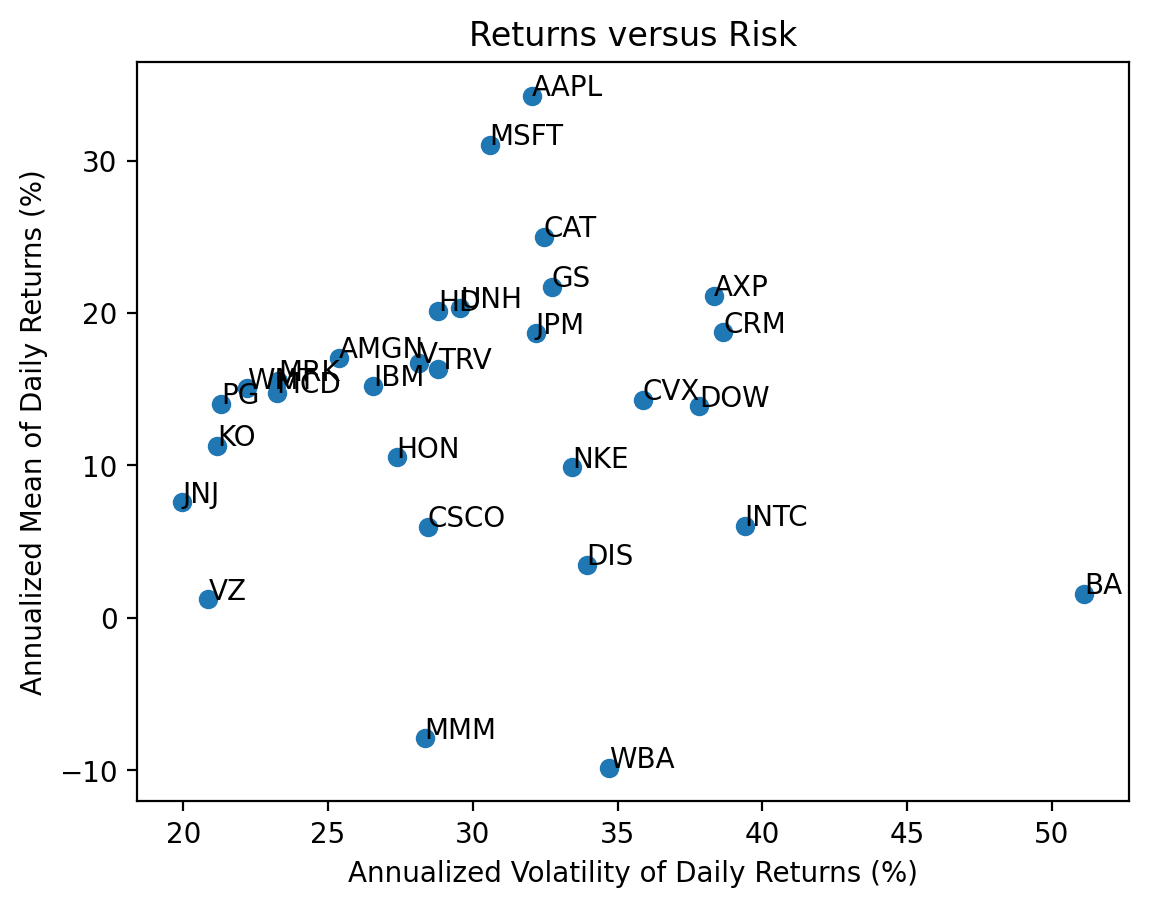
With 30 stocks we see there is no relation between returns and volatility because most volatility is diversifiable and uncompensated.
3.6 Calculate total returns for the stocks in the DJIA
We can use the .prod() method to compound returns as \(1 + R_T = \prod_{t=1}^T (1 + R_t)\). Technically, we should write \(R_T\) as \(R_{0,T}\), but we typically omit the subscript \(0\).
In general, I prefer to do simple math on pandas objects (data frames and series) with methods instead of operators:
For example:
.add(1)instead of+ 1.sub(1)instead of- 1.div(1)instead of/ 1.mul(1)instead of* 1
The advantage of methods over operators, is that we can easily chain methods without lots of parentheses.
total_returns2 = returns2.add(1).prod().sub(1)

total_returns2.iloc[:5]
AAPL 3.1210
AMGN 0.9635
AXP 0.9687
BA -0.4289
CAT 1.6083
dtype: float643.7 Plot the distribution of total returns for the stocks in the DJIA
We can plot a histogram, using either the plt.hist() function or the .plot(kind='hist') method.
A histogram is a great way to visualize data!
start_date = returns2.index.min()
stop_date = returns2.index.max()

(
    returns2
    .add(1)
    .prod()
    .sub(1)
    .mul(100)
    .plot(kind='hist', bins=20) # grids=True to add grid lines
)
plt.xlabel('Total Return (%)')
plt.title(f'Distribution of Total Returns for DJIA Stocks\n from {start_date:%B %Y} to {stop_date:%B %Y}')
plt.show()
With only 30 stocks, we can actually connect a stock to its return in a plot!
start_date = returns2.index.min()
stop_date = returns2.index.max()

(
    returns2
    .add(1)
    .prod()
    .sub(1)
    .sort_values() # sort by total returns
    .mul(100)
    .plot(kind='barh') # horizontal bar chart
)
plt.xlabel('Total Return (%)')
plt.title(f'Distribution of Total Returns for DJIA Stocks\n from {start_date:%B %Y} to {stop_date:%B %Y}')
plt.show()
3.8 Which stocks have the minimum and maximum total returns?
If we want the values, the .min() and .max() methods are the way to go!
total_returns2.min()-0.5384total_returns2.max()3.1210The .min() and .max() methods give the values but not the tickers (or index). We use the .idxmin() and .idxmax() to get the tickers (or index).
total_returns2.idxmin()'WBA'total_returns2.idxmax()'AAPL'Here is what I would use!
total_returns2.sort_values().iloc[[0, -1]]WBA -0.5384
AAPL 3.1210
dtype: float64Not the exactly right tool here, but the .nsmallest()' and.nlargest()` methods are really useful!
total_returns2.nsmallest(3)WBA -0.5384
MMM -0.4408
BA -0.4289
dtype: float64total_returns2.nlargest(3)AAPL 3.1210
MSFT 2.6028
CAT 1.6083
dtype: float643.9 Plot the cumulative returns for the stocks in the DJIA
We can use the cumulative product method .cumprod() to calculate the right hand side of the formula above.
start_date = returns2.index.min()
stop_date = returns2.index.max()

(
    returns2
    .add(1)
    .cumprod()
    .sub(1)
    .mul(100)
    .plot(legend=False) # with 30 stocks, this legend is too big to be useful
)

plt.ylabel('Cumulative Return (%)')
plt.title(f'Cumulative Returns for DJIA Stocks\n from {start_date:%B %Y} to {stop_date:%B %Y}')
plt.show()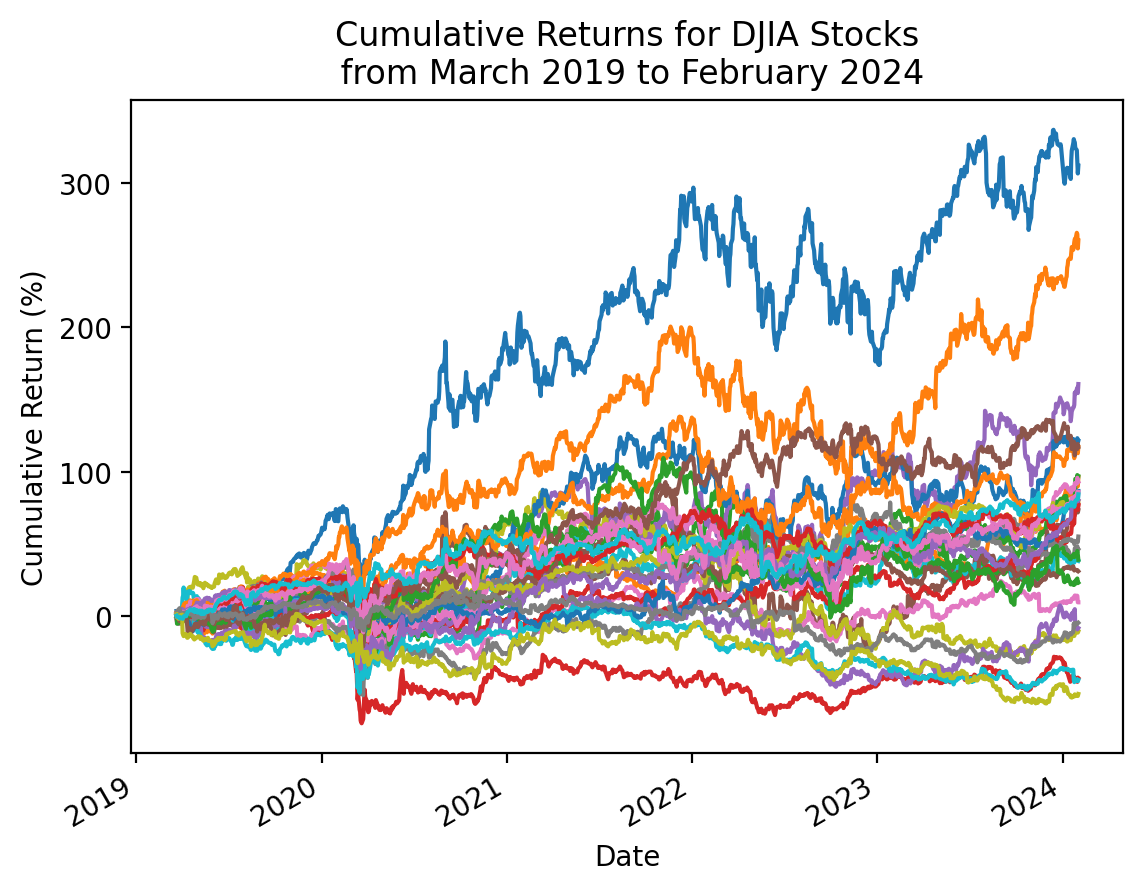
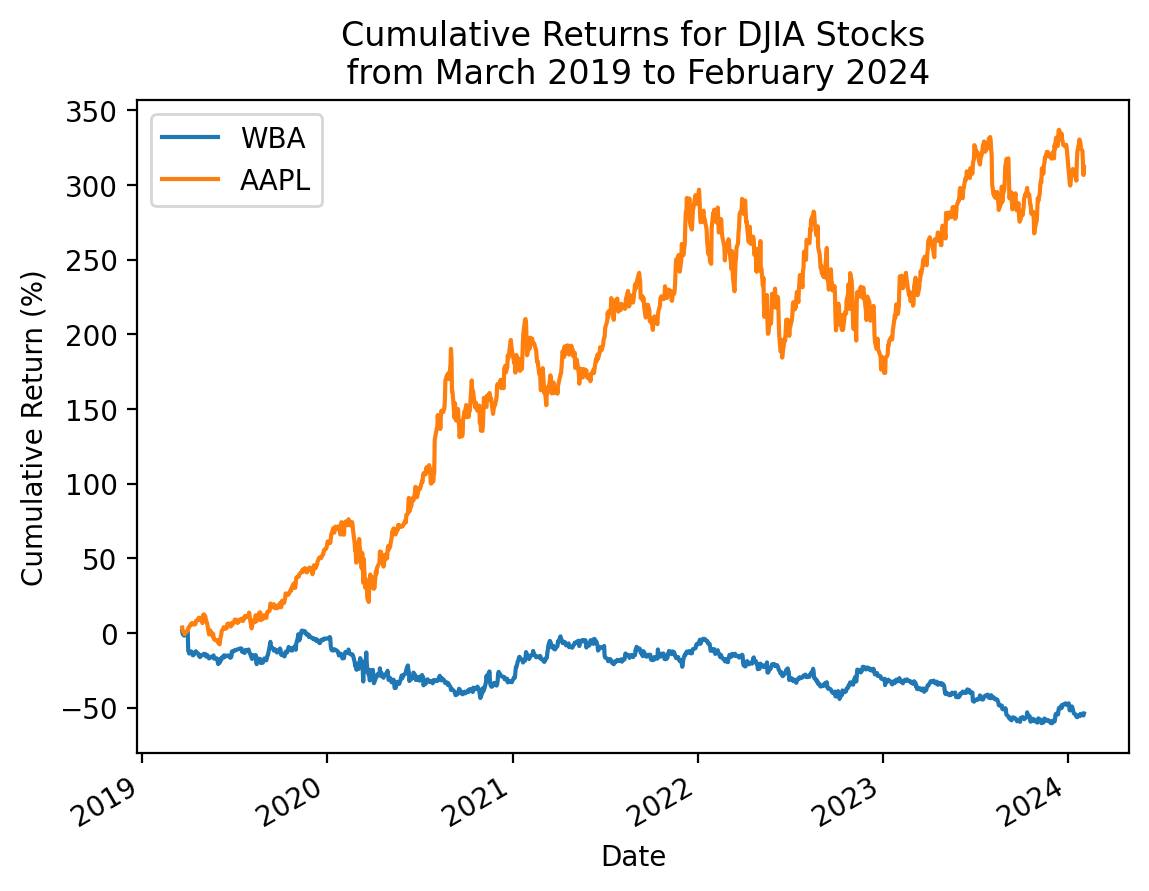
3.10 Repeat the plot above with only the minimum and maximum total returns
total_returns2.sort_values().iloc[[0, -1]].indexIndex(['WBA', 'AAPL'], dtype='object')returns2[total_returns2.sort_values().iloc[[0, -1]].index]| WBA | AAPL | |
|---|---|---|
| Date | ||
| 2019-03-21 | 0.0129 | 0.0368 |
| 2019-03-22 | -0.0187 | -0.0207 |
| 2019-03-25 | -0.0115 | -0.0121 |
| 2019-03-26 | 0.0037 | -0.0103 |
| 2019-03-27 | 0.0050 | 0.0090 |
| ... | ... | ... |
| 2024-01-26 | -0.0113 | -0.0090 |
| 2024-01-29 | -0.0057 | -0.0036 |
| 2024-01-30 | 0.0018 | -0.0192 |
| 2024-01-31 | -0.0083 | -0.0194 |
| 2024-02-01 | 0.0301 | 0.0133 |
1226 rows × 2 columns
start_date = returns2.index.min()
stop_date = returns2.index.max()

(
    returns2 # all returns for all stocks
    [total_returns2.sort_values().iloc[[0, -1]].index] # slice min and max total return stocks
    .add(1)
    .cumprod()
    .sub(1)
    .mul(100)
    .plot()
)
plt.ylabel('Cumulative Return (%)')
plt.title(f'Cumulative Returns for DJIA Stocks\n from {start_date:%B %Y} to {stop_date:%B %Y}')
plt.show()